The GNU Manifesto
Richard Stallman's declaration that software should be free, and the legal hack that made it stick.
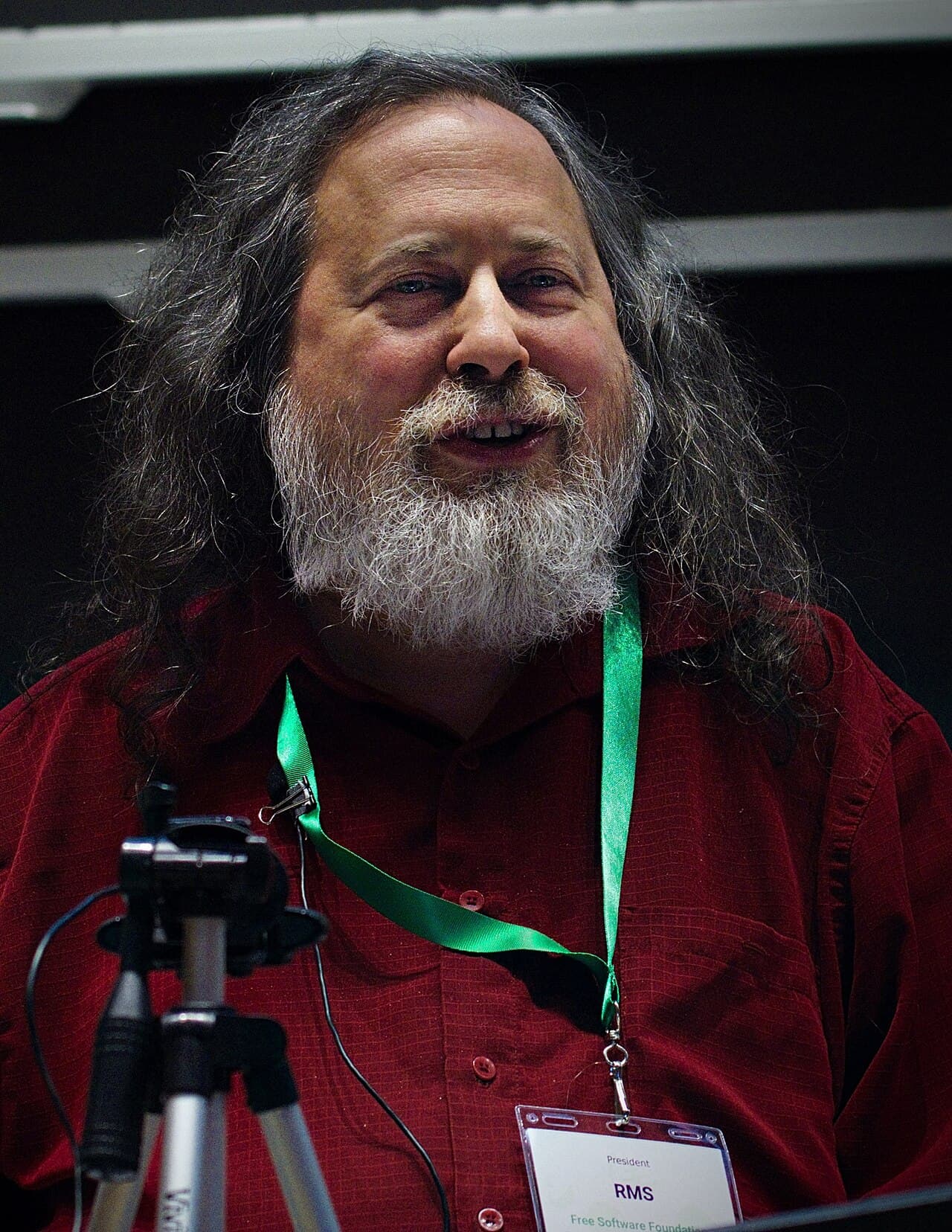
The object
The GNU Manifesto, written by Richard Stallman and published in March 1985 in Dr. Dobb's Journal, asks for collaborators to build a complete Unix-compatible operating system that anyone could use, study, modify, and redistribute. Stallman had announced the GNU Project the previous September, in a message to Usenet newsgroups, and resigned from his MIT staff job so the Institute could not claim ownership of the code. "GNU" stands, recursively and pointedly, for "GNU's Not Unix," a joke in the grammar of the hackers it was written for.
From a broken printer to a movement
The origin story is small and human: a Xerox laser printer (a 9700 donated to the MIT AI Lab) kept jamming far down the hall, and unlike the previous machine, its software was closed. Stallman had once patched an earlier printer to notify users when it jammed; this time the manufacturer refused to release the source code that would let him do the same. He generalized the frustration into a principle. Software that users cannot inspect or change makes them powerless. The remedy was not better vendors but a different definition of ownership. The collapse of the Lab's old hacker culture in the early 1980s, as colleagues left for proprietary startups like Symbolics and Lisp Machines, Inc., sharpened his resolve to build something that could not be taken private.
Why it matters
The manifesto's deepest move was legal, not technical. The GNU General Public License, whose first general version Stallman released in 1989, used copyright against itself: software could be copied and modified freely, on the binding condition that derivative works carry the same freedoms forward. "Copyleft" turned a tool of restriction into a tool of liberation, distilled in the slogan "free as in freedom, not free as in beer." It is one of the most elegant hacks ever performed, worked on the law rather than a machine. To carry the work, Stallman founded the Free Software Foundation in 1985, and over the following years the project produced cornerstone tools still in daily use: the GCC compiler, the GNU Emacs editor, the GNU C Library, and the Bash shell.
What the project lacked was a kernel; its own, GNU Hurd, came slowly. When Linus Torvalds released the Linux kernel in 1991 and placed it under the GPL in 1992, GNU's components combined with it to form a complete system, GNU/Linux, that now runs most of the internet's servers, the Android phones in billions of pockets, and the supercomputers at the top of every performance list. The ethic of Spacewar! and the Homebrew newsletter was here given a constitution.
The lesson it set loose
Freedom in software is not a feeling; it is a structure you can encode and enforce. By treating a license as a program, Stallman showed that the most powerful hacks are sometimes performed on the rules themselves.
Further reading
Keep exploring
Next exhibit
The WELL