The Altair 8800
A mail-order metal box with switches and blinking lights that convinced thousands they could own a computer.
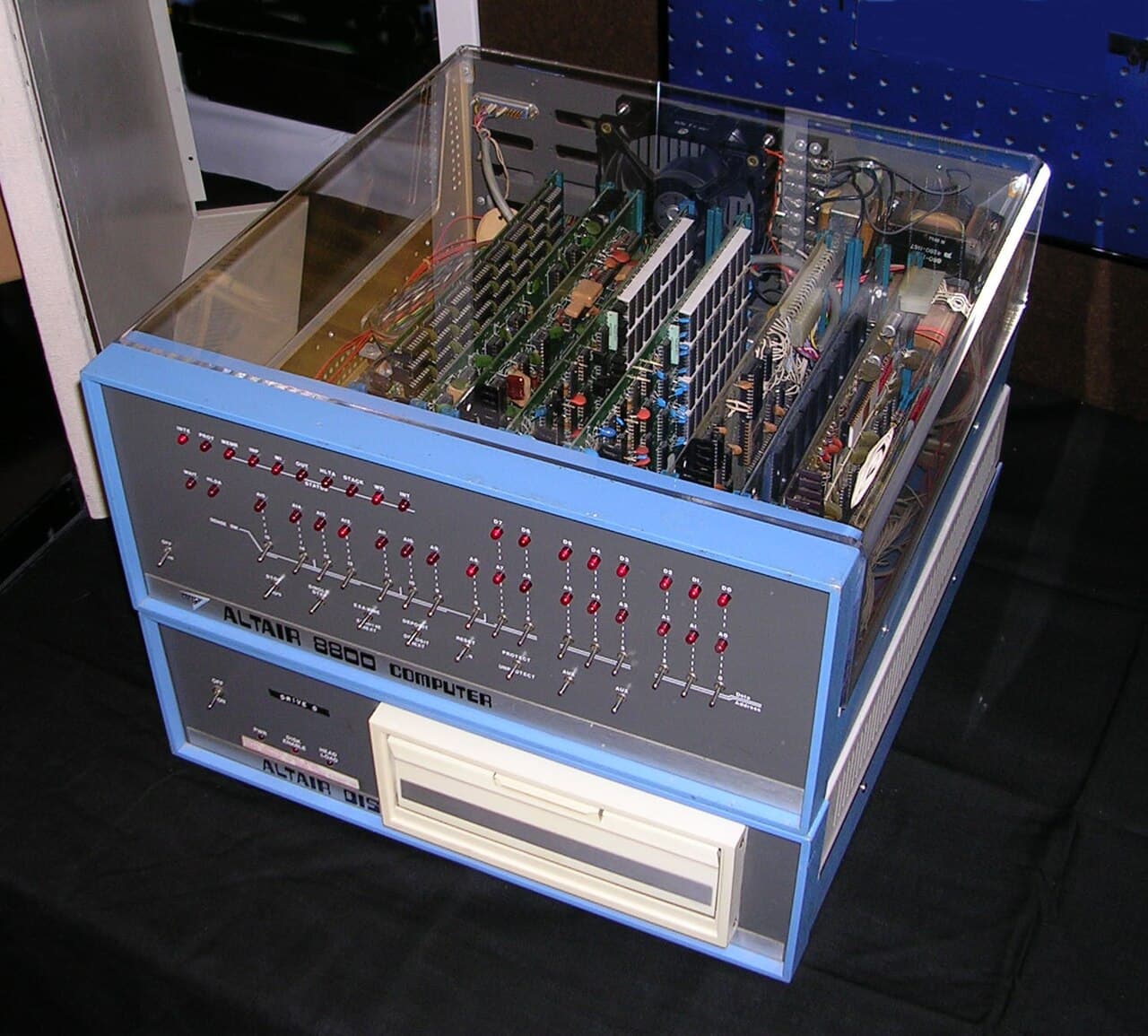
The object
The Altair 8800, built by Micro Instrumentation and Telemetry Systems (MITS) of Albuquerque, New Mexico, reached the public on the January 1975 cover of Popular Electronics under the headline "World's First Minicomputer Kit to Rival Commercial Models." It was a kit: a steel-and-aluminum chassis, an Intel 8080 microprocessor clocked at 2 MHz, a row of front-panel toggle switches for entering binary instructions, and red LEDs to read the results. The base machine sold for $439 as a kit (roughly $397 assembled was promised but rarely delivered on time), against the thousands of dollars a minicomputer like the DEC PDP-8 then cost. It shipped with 256 bytes of memory, no keyboard, no screen, and no software. To make it do anything, you toggled programs in one bit at a time. By any practical measure it was useless. And it changed everything.
MITS founder Ed Roberts, a former Air Force engineer whose calculator business had been crushed by Texas Instruments, gambled the company on the machine. He had hoped to sell perhaps a few hundred to break even. Within weeks of the magazine reaching newsstands, MITS had taken thousands of orders and was effectively insolvent in reverse, drowning not in debt but in checks it could not fill fast enough.
A box that started an industry
The Altair's importance was not what it did but what it proved: that an individual, not an institution, could own a computer. The deluge of orders buried MITS, and a backlog of months became normal. Hobbyists who bought it had to invent the rest, and they did. The machine's open Altair bus, soon standardized by the industry as the S-100 bus, let third parties build memory boards, interface cards, and peripherals MITS never made, seeding an entire components economy.
Two Harvard students, Paul Allen and Bill Gates, read the Popular Electronics cover and called Roberts claiming to have a BASIC interpreter for the 8080. They did not yet have one; they wrote it on a PDP-10 emulator over a few intense weeks, and Allen debugged it on the flight to Albuquerque. Altair BASIC worked on the first live demonstration, and the partnership the two formed to sell it, first called Micro-Soft, became Microsoft. On the West Coast, the Homebrew Computer Club convened in Menlo Park in March 1975 in part to figure out what to do with these machines; among its members was Steve Wozniak, who would soon design the Apple I.
Why it matters
The Altair turned the abstract promise of personal computing into solder, switches, and a shipping address. It is the physical seed of the home-computer revolution: not elegant, not finished, but real and yours. The first World Altair Computer Convention in Albuquerque in 1976 drew hundreds of devotees of a machine barely a year old. Everything in this museum's personal-computing wing descends from the moment a hobbyist flipped its switches and watched the lights answer.
The lesson it set loose
A tool does not need to be polished to be revolutionary; it needs to be accessible. The Altair was barely a product, but it was a permission slip. It told a generation that the computer was no longer something you visited in a climate-controlled room behind glass. It was something you could build, own, and bend to your will. MITS itself did not last; Roberts sold the company to Pertec in 1977 and went on to study medicine, becoming a small-town doctor in Georgia. The machine outlived its maker as an idea, which is the only way machines ever truly last.
Further reading
Keep exploring
Next exhibit
The Chaos Computer Club