The Homebrew Computer Club Newsletter
A photocopied bulletin that turned hobbyists into an industry and made personal computing a shared project.
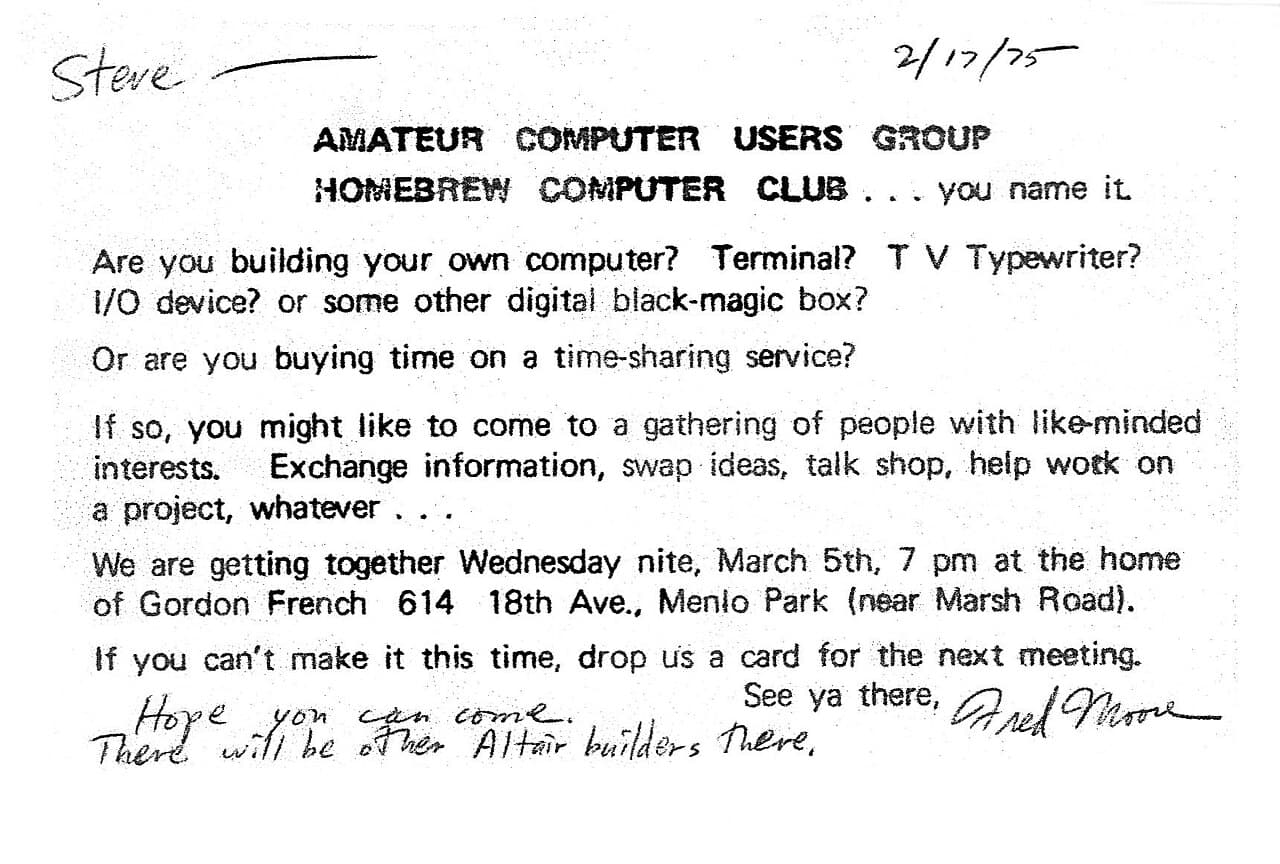
The object
The Homebrew Computer Club Newsletter was a stapled, typewritten bulletin edited by Fred Moore and circulated to members of a Silicon Valley hobbyist club that met, beginning on 5 March 1975, in Gordon French's garage in Menlo Park and soon moved to the Stanford Linear Accelerator Center auditorium. It carried schematics, parts sources, want-ads, meeting notes typed up by Moore from his own scribbled records, and unfiltered opinion. Across roughly twenty-one issues it became the connective tissue of the early microcomputer world.
A room full of builders
Homebrew formed weeks after the Altair 8800 appeared on the January 1975 cover of Popular Electronics; an Altair was passed around at that first meeting of about thirty people. For the first time, an individual could own a computer. The club's culture was radically generous: members demonstrated their machines, handed over circuit designs, and helped competitors debug. Meetings followed an informal "random access" period where members traded chips, tips, and gossip in the parking lot afterward. The roster was extraordinary: Lee Felsenstein, who chaired the meetings and would design the Osborne 1; Steve Wozniak and Steve Jobs; Adam Osborne; and the founders of companies like Cromemco and Processor Technology. The newsletter was the network that made that generosity scale beyond a single auditorium.
Why it matters
It was at Homebrew that Steve Wozniak unveiled the Apple I and, in keeping with the club's spirit, handed out photocopies of its design schematics for free. He later said he simply wanted other hobbyists to be able to build one. Roughly two dozen companies trace their origin to that room. The newsletter is the documentary record of the moment computing escaped the institution and entered the home.
It also staged the movement's first great argument. In early 1976 a 20-year-old Bill Gates, frustrated that hobbyists were freely copying Altair BASIC on punched paper tape, wrote his "Open Letter to Hobbyists," which spread through the newsletter's orbit and condemned such copying as theft: "As the majority of hobbyists must be aware, most of you steal your software." The reaction was furious, and the clash between sharing and ownership that defines computing was articulated here, in mimeograph, years before the words "free software" or "open source" existed.
The lesson it set loose
A community that freely shares what it learns advances faster than any single firm. The personal computer was not invented by a company; it was assembled in public, one photocopied page at a time. The club itself dissolved by the mid-1980s, its work done once the industry it spawned no longer needed a garage. But the tension introduced in those pages (is software a craft to share or a product to sell?) has never been resolved, only inherited, by every license, app store, and open-source repository that followed.
Further reading
Keep exploring
Next exhibit
The Altair 8800