Spacewar!
The first widely shared digital video game, written for fun on a $120,000 machine that was never meant to play.
The object
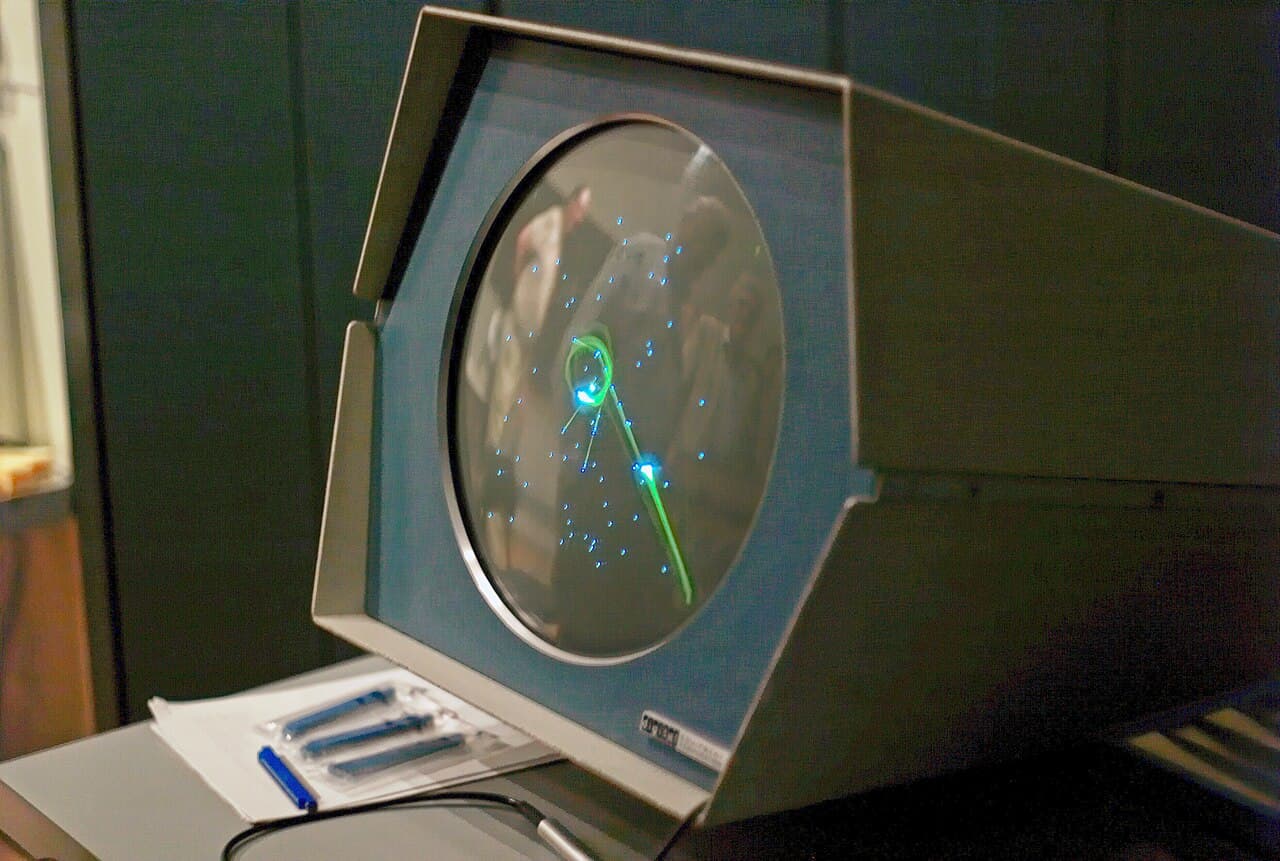
Spacewar! is a two-player game of dueling spaceships orbiting a star, written in 1962 on MIT's new PDP-1 minicomputer. Each player commands a ship, nicknamed the needle and the wedge, firing torpedoes while a central sun drags every object toward it with simulated gravity. The display was a circular CRT, and control passed to custom boxes wired up because the machine's toggle switches blistered the players' elbows. There was no commercial reason to build it. It existed because the machine made it possible and the people around it could not resist finding out what it could do.
Digital Equipment Corporation had donated the PDP-1 to MIT in 1961, a machine that cost roughly $120,000 at a time when most computing meant batch jobs queued on million-dollar mainframes you never touched directly. The PDP-1 was interactive: you sat at it, saw results on a screen, and reacted in real time. That intimacy is what Spacewar! exploited.
The Tech Model Railroad Club
The PDP-1 lived among the students of MIT's Tech Model Railroad Club, the room where the word hacker acquired its original meaning: not a criminal, but someone who pursued a clever, joyful mastery of a system for its own sake. The TMRC's Signals and Power Subcommittee, which wired the club's elaborate layout, supplied much of the early vocabulary and many of the people who migrated to the new machine.
Steve Russell, known as "Slug," wrote the core program over the winter of 1961–62, reportedly putting in some 200 hours, and procrastinated so long on the hard math of orbital motion that Alan Kotok drove to DEC to fetch the sine-cosine routines that broke the impasse. Others piled on: Peter Samson added Expensive Planetarium, replacing the random dots with the real night sky down to roughly fifth magnitude; Dan Edwards rewrote the physics so the sun's gravity became a tactical hazard; Martin Graetz contributed the hyperspace panic button that flung a ship to a random location at the risk of never returning. Spacewar! was their proof of concept for an entire way of relating to computers.
Why it matters
The game was given away. There was no notion of selling it; source code traveled with PDP-1 machines to other labs, and DEC itself is said to have used Spacewar! as a diagnostic to test new units before shipping. Players everywhere kept improving it: open, collaborative, and refined by nearly everyone who touched it, software as a shared craft rather than a guarded product. Decades before "open source" had a name, Spacewar! was already practicing it.
It also seeded an industry. Nolan Bushnell encountered it as an engineering student at the University of Utah and, with Ted Dabney, built the 1971 arcade machine Computer Space directly from its premise; the pair then founded Atari in 1972. In 1972 Rolling Stone sent Stewart Brand to MIT to write "Spacewar: Fanatic Life and Symbolic Death Among the Computer Bums," one of the first reports to tell the wider public that something cultural, not merely technical, was happening around these machines.
The lesson it set loose
The most consequential things built with a powerful tool are often the ones it was never designed for. Curiosity, not specification, is what reveals what a machine truly is. The hackers at the TMRC understood that the point of access to a computer was not productivity; it was discovery.
Further reading
Keep exploring
Next exhibit
The Blue Box