The Blue Box
A pocket-sized tone generator that turned the global telephone network into a hacker's playground.
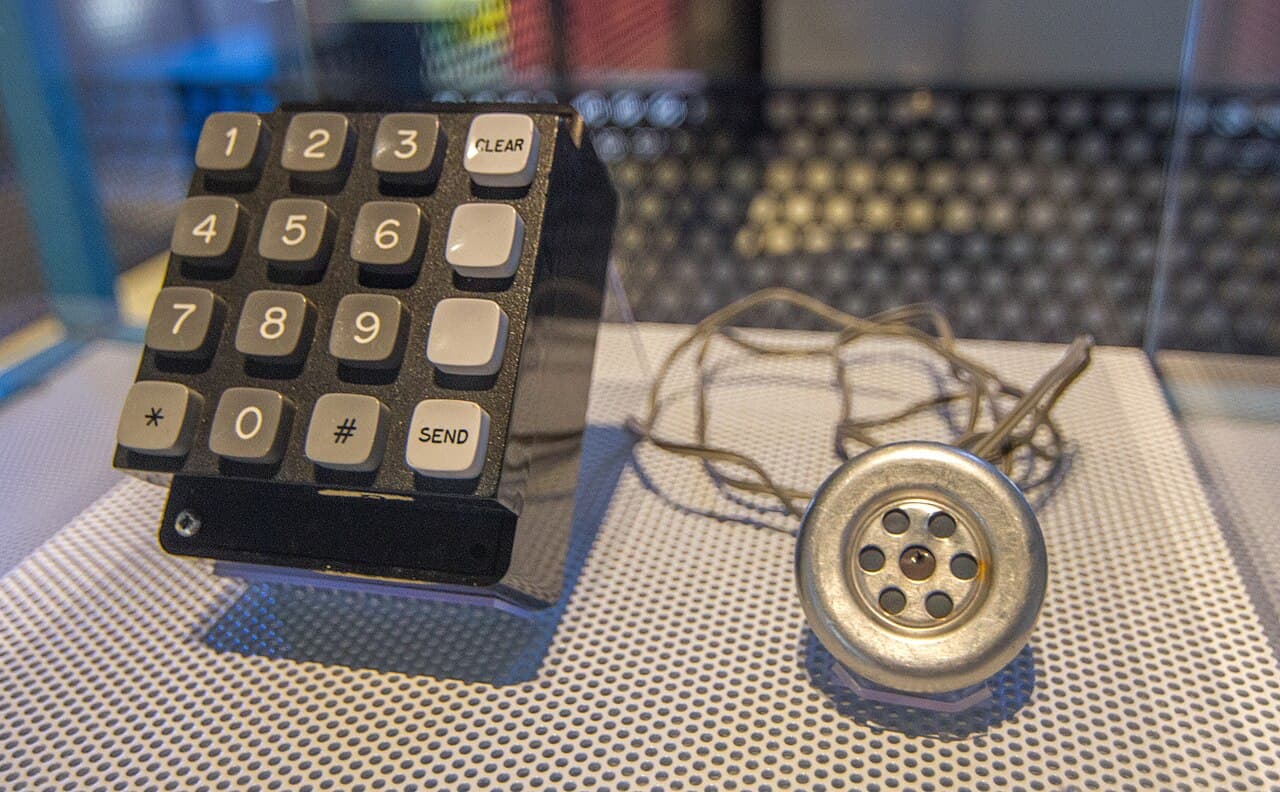
The object
A blue box is a small electronic device that emits the precise multi-frequency tones AT&T used to route long-distance calls. The Bell System's automated switches communicated with one another in-band, over the very same voice channel that carried the conversation, using a scheme called Signaling System 5 and a set of "multi-frequency" pairs to dial digits from one exchange to the next. Whoever held a blue box could speak the telephone network's own private language directly into the mouthpiece, and the network, trusting any voice that spoke it, obeyed.
The 2600 Hz accident
The system had a flaw hiding in plain sight. A trunk line listened for a single 2600 Hz tone to know it was idle and ready for a new call. The vulnerability was effectively published by the phone company itself: technical articles in the Bell System Technical Journal in the 1950s and 1960s laid out the exact signaling frequencies. In October 1971, Esquire ran Ron Rosenbaum's article "Secrets of the Little Blue Box," which introduced a mass audience to a hidden subculture and to John Draper, "Captain Crunch," who took his handle from the discovery that a toy bo'sun whistle packaged in Cap'n Crunch cereal produced a tone very close to 2600 Hz. Blow the whistle into the line, seize the idle trunk, then key in the routing tones to dial anywhere on Earth for free. Blind teenagers, among them the legendary Joe Engressia, "Joybubbles," who could whistle 2600 Hz with his own mouth, formed an early and gifted core of the community.
Why it matters
The blue box is the founding artifact of phreaking, the exploration of telephone systems that preceded computer hacking and shaped its ethic. It was never really about free calls. It was about the thrill of understanding a vast, opaque machine, the largest one ever built, spanning a continent, well enough to make it sing.
Two of its most famous builders were Steve Wozniak and Steve Jobs, who read the Esquire piece, tracked down Draper, and built their own digital blue box in 1972, selling them for around $150 door-to-door in Berkeley dorms before they built a computer company. Their exploits included Wozniak placing a prank call routed around the world and, by some tellings, to the Vatican. Wozniak later said it plainly: without the blue box, there would have been no Apple. The era did not end cleanly. Draper was arrested for toll fraud, and AT&T's eventual migration to out-of-band signaling (Common Channel Signaling, later SS7) in the following decades finally closed the door the whistle had opened.
The lesson it set loose
Systems trust their own signals. A network that cannot tell the difference between a legitimate command and a perfect imitation of one is not secure; it is merely unchallenged. The flaw was architectural: mixing control signals and user data on the same channel meant any user who could generate the control tones became, in effect, an operator. Every generation of hackers rediscovers this truth in a new medium. The phreaks found it first, with a whistle.
Further reading
Keep exploring
From the same era
Next exhibit
The Jargon File